Wanjiru & Friends: A Conversation on Leadership Transition, Stewardship & Institutional Legacy
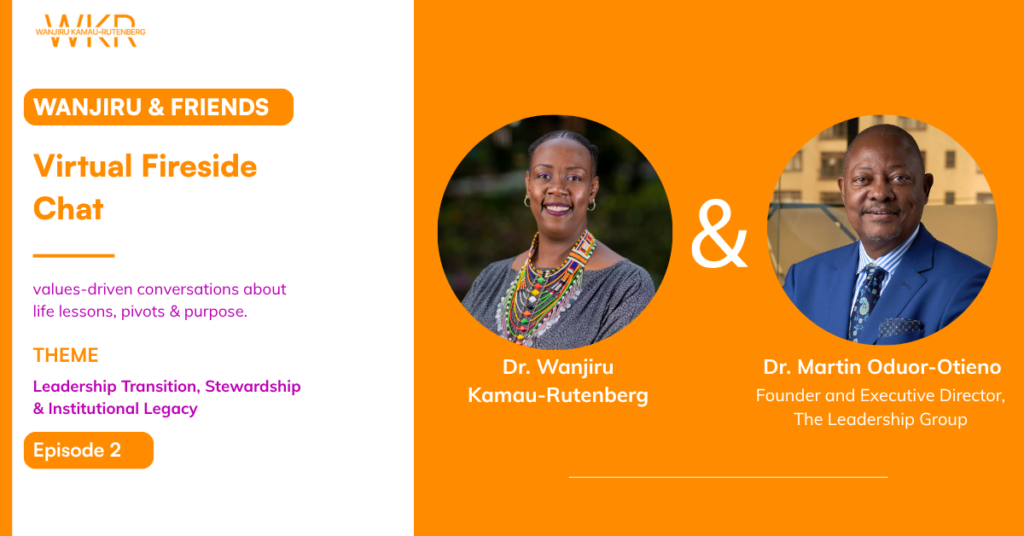
Dr. Martin Oduor-Otieno, PCC, CBS has earned nearly every title African leadership has to offer — Chief Executive Officer, Permanent Secretary, Board Chairman, Non-Executive Director, Chancellor, Founder and the Government of Kenya capped them all by decorating him as Chief of the Order of the Burning Spear.
Most recently he founded The Leadership Group, a consulting firm specializing in strategy, governance, leadership, and culture, and authored The Humanized Leader, a blockbuster book that teaches what conventional leadership training misses: how to lead with humanity without sacrificing performance. His frameworks are grounded in African contexts, real-world performance pressures, and — as a Professional Certified Coach — years of coaching C-suite executives through actual transformation.
I know this firsthand. I have been his coaching client for years, and I attribute much of my recent career success to his guidance; the frameworks he taught me have shaped some of my weightiest career decisions.
So this conversation is personal. Over its course we ranged from how coaching found him through a closed door in Dar es Salaam, to preparing women for boardrooms and to hold their ground once inside them, to why empathy and results were never in competition, to the discipline of going home at 5pm, to legacy as the story told when you are not in the room.
What follows is that conversation, distilled into six short essays in Martin’s own voice. I commend them to anyone building the next generation of African institutions
You’ve led transformations at KCB, served as Kenya’s Permanent Secretary for Treasury, and now chair major boards across Africa. When you entered spaces where institutional memory was resistant to change particularly around diversity and inclusion, how did you distinguish between preserving what makes institutions durable versus dismantling what makes them exclusionary? What should Black women leaders specifically preserve versus disrupt as they build the next generation of African institutions?
Change is constant – I mean, change is the only thing we are sure about, as the saying goes. But it is also true that people are resistant to change.
As human beings, we like our comfort zones, we like what we have always done historically. And so the first thing we need to think about is: what is the motivation for change, and what is this change actually about? What is the need? Because in any change, there is a sense of loss and gain. And whenever people feel that there is a sense of loss, they are likely to resist. And so even as you go into a change situation, you have to begin thinking about how you position it not so that people feel they are losing something, but so they can still see the positive side of what this change brings. Whether you are talking about change in terms of diversity, processes, systems, the way we do things so for leaders, it is important to hold that awareness, because some of the resistance is driven by fear, and some of it is simply: what are you taking away from me?
I write about this in my two books, and I lived it when I walked into the Ministry of Finance as Permanent Secretary. I had never worked in government. I was a stranger, an outsider. I sit at this table — I am the senior person in the room — and I call all these big, serious economists into the conference room. And they are looking at me strangely. First, because: who is this guy? He doesn’t really belong here. He has been parachuted into our space. He is not an economist. Why should we even listen to him? And yet I was in a position of power and authority, I was now the Permanent Secretary. And so the first time, it is just silence. We are not talking. But over time, as I begin to paint a picture of where our country is today, what is happening or not happening, what could the future look like, what is in this future for you, and why should you come to the table with me? Then, I start seeing people opening up. They begin to think: maybe there is something here for us. Maybe we should listen. Maybe we should start making contributions. That is when I begin to say: OK, if we are going to make a change, what kind of change is it going to be, and what will it result in? And then, who wants to be part of this change? Because you want to start building a community of believers. The concept of change champions, the concept of empowerment, letting people begin to think about what is important, what the priorities are, how we create this change, who needs to come to the table, and how we drive it together.
Now, when it comes to diversity and specifically bringing Black women into these spaces, I ask the same questions. What is the change we are trying to create? What is the need? And for those who are the change leaders, why should men open up a space that has previously been made an exclusive zone? Is it because men begin to get better perspectives? Is it because women are half the population of the world and therefore should not be less than ten percent of whatever community there is? What is it that they bring that doesn’t exist in those spaces at the moment?
And my answer to that, from the vantage point of having sat on a number of boards – I am a great advocate for women being in the same spaces as men. When I go into a boardroom and find a board of seven with one woman and six men, I am advocating: why not three, four, five women here? And my justification is simply this: we are missing something. We are not hearing a critical voice in this conversation. We are not hearing different perspectives. We are not hearing the feminine voice. And I can give you a very concrete example, when a board is discussing letting people go during tough times, and the men are all nodding along, it is often the woman in the room who stops and says: yes, but how are we looking after them as they leave? Are we just throwing them out of the window or are they having a soft landing? Have we discussed that? Can we make that part of the process? Something that someone else would have overlooked completely. That is the context in which I look at this.
And when I go and speak to women’s book clubs that are reading The Humanized Leader they tell me that historically, leadership has been the preserve of men, and at times men come with a lot of macho, strong-arm tactics, aggression, and no empathy. And when they read about empathy, about creating the right environment, about empowerment, inclusion, collaboration – they say: yes, there is something here for us. This is what we have been yearning and fighting for all our lives. Men are also reading this book, but women are more intentional in following through on the themes of the book. And that intentionality is exactly what is needed as we build the next generation of African institutions.
In your book The Humanized Leader, you talk about ‘humanized leadership’ – holding power and empathy in the same hand. But you’ve also said leaders must make decisions and cannot sit on the fence. For Black women leaders navigating this tension in predominantly male, homogenous boardrooms and executive teams, how do you coach them to stay human without being perceived as weak, and to lead decisively without losing relational capital?
There is a researcher I want you to look up, Ananya Sengupta, based at a university in the UK, who recently completed her PhD on something called Paradox. I know her because she reached out to me when she was doing her research, and I later invited her to speak at one of my Leadership Group webinars on this very topic. And the reason I bring her up is because this question, how do you hold power and empathy at the same time and still get results – is exactly what her research speaks to. How can I have this and that? Which is right and which is not? That tension is real, and it deserves a serious answer.
So let me start here: being human is not equal to being weak. This is a question that comes up often at the book clubs reading The Humanized Leader – people ask, if you show empathy, if you are a humanized leader, won’t people take advantage of you? Won’t they think you are not serious? Won’t they just do as they please because you keep saying yes? And my answer is always the same. Being human is not setting yourself up so that people take advantage of you. Being human means being empathetic in a way that recognizes we are all human beings — we all have the same needs, the same feelings, we all like to be treated well, and we all start off with good intentions until we are proved otherwise.
What actually matters is how you interpret the word power. Does power mean that you rule over people, that you beat them on the head so they perform? Or does it mean that you create the right environment, the right climate, a supportive and learning environment where people can actually thrive? I think of Satya Nadella, CEO of Microsoft, who talks about building a learn-it-all culture as opposed to a know-it-all culture. Because a know-it-all culture brings in a very specific power dynamic – I am senior, I have been here longer, I know more than you, and therefore I have the power. But a humanized leader creates an environment where people learn continuously, where people can make mistakes and be vulnerable, where a leader can say I don’t know and seek help without it being a sign of failure.
In that space, power and empathy are not opposites – they coexist. I am not weak because I am empathetic. I am not powerful because I lord it over you. You still recognize that I am the CEO – that is fine – but I am here to support you. And because we want to innovate, we have to allow mistakes, as long as people learn from them and do not keep repeating the same ones. That is where the empathy piece lives. There is compassion. There is clarity. There is support. There is the recognition that you are just as human as I am – you have feelings. And when I walk into the office every morning and shout at you and scream at you and beat you on the head, that is not going to deliver the outcomes I am looking for. That is the interplay we are talking about when we talk about humanized leadership. Empathy and results are not in competition. The right environment produces both.
You emphasize that leaders must mentor other people to bring out the best, invest in them. But mentorship for women, especially Black women in Africa is often performative – visible in programs but invisible in succession planning. You’ve mentored executives who went on to lead major institutions. What did you do differently that actually opened doors versus simply opening conversations? And what do you think Black women should demand from mentors to ensure they’re not just being developed, but actually being positioned? What do you think about being a mentor on boards?
Before I get into mentorship on boards specifically, let me say something about coaching, because it connects directly to this. Coaching provides two things: awareness and clarity. Awareness – what is around me as a leader, what is leadership, what do I want to deliver, what could derail me? And clarity — this is the objective, this is the goal, this is what I have and this is what I don’t have, and therefore this is where I go and this is where I don’t go. When I am coaching, the clarity is provided by spending time landing on what the goal or objective is that we want to achieve. The awareness is everything else happening around that — what can support it and make it happen, and what can derail it and stop it from happening. That is the foundation everything else is built on.
Now, everybody — and I mean every woman — wants to be on a board. People come to me through coaching, through leadership development programs, and it feels like boards are the latest thing, the destination everyone must get to. And so the first thing I do in mentorship is get them to really understand the why. Is it just a glamorous thing, a prestigious place you want to get to? Because there is hard work on that side as well. Are you ready for that hard work? So let us first understand what being on a board actually is — what boards do, what is required. Get out your Excel sheet, your clarity sheet, and start working through it. What do I really want to do on a board? What kind of boards do I actually want to be on? And that knowledge can come in many forms — go and do some training, the IOD programs or whatever is available, talk to people who already serve on boards, understand what the work actually looks like before you get there.
Beyond that, mentorship for me means identifying where the opportunities are and assessing where the suitability of a particular individual lies. And then acting as a reference — pointing to opportunities, making introductions, saying: there are openings in these kinds of spaces, would those interest you? Go out for those interviews, find those networks, go and talk to the people in those rooms. Another thing I have done, though not as often, is shadowing — asking a board for permission to bring a young woman along to sit in a corner of the boardroom and observe what those conversations actually look like. Now, boards are confidential spaces, so this is not always possible. But what you can do — and what I do during training — is simulate it. Have an actual dummy board, give people roles around the table: you are the chair, you are on the audit committee, you are on the HR committee. Here is a case study — now act as a board. And I sit back, observe, and give feedback on how that board practice went. That combination of knowledge, practice, and real board exposure is what mentorship on boards looks like for me. Women are very intentional about these things — and I love that about them.
And crucially, the mentorship does not stop once they get onto a board. Even as they attend their first substantive board meeting, their second, you continue. Because the situations that arise are ones you cannot fully prepare for in a training room. I had a conversation recently — maybe two weeks ago — with a woman who told me she was in a boardroom, one of only two women, and the chairman looked directly at her and asked her to go and get him a cup of tea. And she was wondering whether she should do it or not. And I said to her: is he sending you because you are a woman? And she said — he did not look at any of the men in the room and ask them. And here is what I told her: if we are all standing at a tea station, I, as Martin, have absolutely no problem serving you tea. But I would not single you out in a boardroom and say, go and bring me tea. And so women have also got to learn to stand for what is right for them. That is part of what mentorship teaches — not just how to get into the room, but how to hold your ground once you are in it.
You’ve said that managing expectations is one of leadership’s foremost challenges. Black women leaders often inherit expectations they didn’t set—to fix culture, champion diversity, absorb emotional labor, while delivering financial results. When you coach senior leaders carrying compounding mandates, how do you help them navigate what they own versus what they refuse? Have you seen African institutions redistribute that labor rather than simply celebrate those who carry it?
It comes back to clarity and this is a word I keep returning to because it is the foundation of almost everything in leadership. What is it that I must do? What are my priorities? Because when you are in a role and everything is being thrown at you, you need to get clear on what is yours and what is not. People have job descriptions for a reason. But what happens in reality is that the people who are performing really well, the ones who actually get things done, become the ones everything gets piled onto. I hear this constantly when I coach leaders, they tell me: I have a team of five, and only two or three are actually doing the work. The others are just there. And so what do the high performers do? They take on the work of others because it is urgent, because they cannot wait for someone to drag their feet for two weeks. And I also hear from leaders who say: I am a perfectionist, nobody can do it to my standard, so I try someone once or twice and then I just take it over and do it myself. And there are consequences to all of those choices — if you are doing everything yourself, what else is suffering? What could you be doing with that time instead? These are the conversations we have in coaching.
So if you are a Black woman and everything is being thrown at you, you need to gather the courage to say — this one is mine, and that one is not. How do we get somebody else to pick up the tab on that other side? I remember very early in my working life, there was a Tanzanian woman working with us. We had these very bullying British managers who would pile everything onto the people who were actually delivering. And this lady — she was intelligent, she worked hard, she gave everything. And one day she just had enough. She looked at this manager and said: Mr. Campbell, this is not for me. We have twenty people here. Why is it always me you are sending this to? She said what needed to be said. And I think about that moment often.
I was coaching someone recently — and I am still coaching them — and they said to me: I want to do this, and I want to do that, and I must do this other thing. And I stopped them and asked: so you are here to save the whole world? The penny dropped. Because the truth is — you do all these things, your health suffers, you probably die, and the organisation continues. All these other people go and enjoy their lives, and you are gone. We have got to take care of ourselves so that we can take care of other people. And if we are being loaded with everything, or if we feel we must save the whole world, we need to step back and say: this world will be here even when I am not. I must look after myself.
I had another client — this was just last week — managing a full institutional integration after a takeover, getting instructions from everywhere, old shareholders, new shareholders, everything at once. She told me: Martin, I leave the office at 10, 11 o’clock at night. My husband works in another country. I am home with the dogs and the dogs do not even know me because they never see me. When I drive into the driveway I have to throw something to distract them so I can dash into the house. And the next morning the whole thing repeats. I said to her: what are you trying to prove? These institutions will be here when you are not. You must take care of yourself. So the next time we met for coaching, she told me: yesterday I went home at 5pm. As I was pulling out of the driveway, the boss called and asked where I was and whether we could have a meeting. She said: I am in my car going home. He was horrified. He said: how can you be going home? She said: let me get home and we can have the meeting at 8pm — but from my home. I am not driving an hour back in the middle of the night. I asked her how she felt. She said: I felt liberated. Even just saying out loud that I am in my car going home, that I cannot have a meeting right now — I felt so empowered. And I told her: our coaching is over. Just keep doing that.
I think about the late Bob Collymore at Safaricom during his time there — I genuinely thought they were on the right track. Bob was a humanized leader. He empathized with people, he gave them space and time, he achieved results — but he was not driven by results primarily. He set aside time to have meaningful conversations with people. That is what it looks like when an institution gets it right. I do not know what it looks like there now — I hear different things. But that example showed me that it is possible. The institution can be high-performing and human at the same time. You do not have to choose.
You’ve stepped down from KCB Bank and retired from SOS Children’s Villages. How do you measure legacy when institutions you build might erase you from the story? What have you learned about letting go while staying accountable for what you started?
How do I measure legacy? I measure it by the stories people tell when I am not there — when I am not in the room, when I have left. Today I walk around and people say: that is the CEO of KCB. I left KCB thirteen, fourteen years ago. And I have been reading things on LinkedIn from people I worked with at that time, narrating stories about how I made them feel — one incident, another incident. That is legacy. I also measure it by impact — the impact created through the work I have done. And I measure it by what lasts. At KCA University, there is a library named after me. When people walk into that university, one of the big buildings they see is the Martin Oduor-Otieno Library. And they start wondering — who is this, who was this, why does this building bear his name? And they go looking for the story. That is one kind of legacy. But in other places it is something quieter — what are you leaving behind, what are you being remembered for, and especially in the humanized leadership space: how did you make people feel when you were here? What kind of relationships did you build? What programs did you put in place that endured beyond you? That story — what people are saying about you when you are not in the room — that for me is the definition of legacy.
I want to share a story about William Mutunga, the former Chief Justice of Kenya. I was at Serena, I think, listening to a panel, and this was just before he retired. Someone asked him: Chief Justice, what legacy are you leaving behind? And he did not hesitate. He said: legacy is for historians to write. As for me, I wake up in the morning, I go to work, I give it my utmost best, I go home in the evening, I come back the following day and I do that again. When I leave, the people writing the story will decide whether I was a good Chief Justice or not. But every day, I give it my best. I leave the rest to others to write. That has stayed with me. It is one of the most grounded things I have ever heard a leader say.
And I think the only thing I would add to that and it connects back to the question of power we started with: power, titles, authority, ego. These are the things that move leaders away from being humanized leaders. Because once you start believing that because you have this title, because you have achieved that, you can rub people the wrong way, you must be noticed, you must be the loudest in the room — you have lost the plot. The humanized leader does things in their quiet corner. And those things deliver the legacy we are talking about. They do not have to show it. The results speak for themselves. The way they make people feel speaks for itself. And they are remembered — not because they were the loudest people in the room — but simply because they were good humans.
When leaving KCB, you could have done anything. Why coaching? Was there an aha moment?
I am not sure there was one clean aha moment but let me tell you how it happened. When I left banking, I went into consulting. I joined Deloitte for three years as a partner in financial services, working with leaders in banking, insurance, and so on. And it was during that period that the coaching piece found me, really.
I was doing some consulting work in Tanzania for a bank, and the HR manager came to me and said: Martin, you have been a CEO. We are looking for our next CEO in about a year’s time. We have a bench of senior executives and we want you to coach them so we can see who emerges as the right person for the role. And I said yes, absolutely. I have been a CEO, I know what CEOs do, I can coach these people. So they went through their procurement process to bring me on board. And then, just before they signed off, they asked me where my coaching qualification was. I did not have one. And that was the end of that story.
But something shifted in me at that moment. I thought, there is something here. There is an opportunity, there is a need, and I want to be part of it. So I went to coaching school, got my diploma in six months, and surprise, surprise, they called me back. I returned as one of two or three coaches, and for the next year I was flying to Dar es Salaam every month to coach my three people and coming back. That is where it all started. Not from a grand plan, not from a vision I had mapped out but from a door that closed and then reopened once I had done the work to deserve it.
Ten years down the line, I am absolutely happy doing this. The coaching, the governance work, the culture, the leadership development, the strategy work we do at The Leadership Group, it has all grown over that decade. Sometimes the aha moment is not a flash of lightning. Sometimes it is a procurement officer asking for a qualification you do not have and deciding that is not where the story ends.
For more information about The Leadership Group, visit their website: https://leadershipgroup.co.ke/