Wanjiru & Friends: A Conversation on Leadership, Science & Systems Change
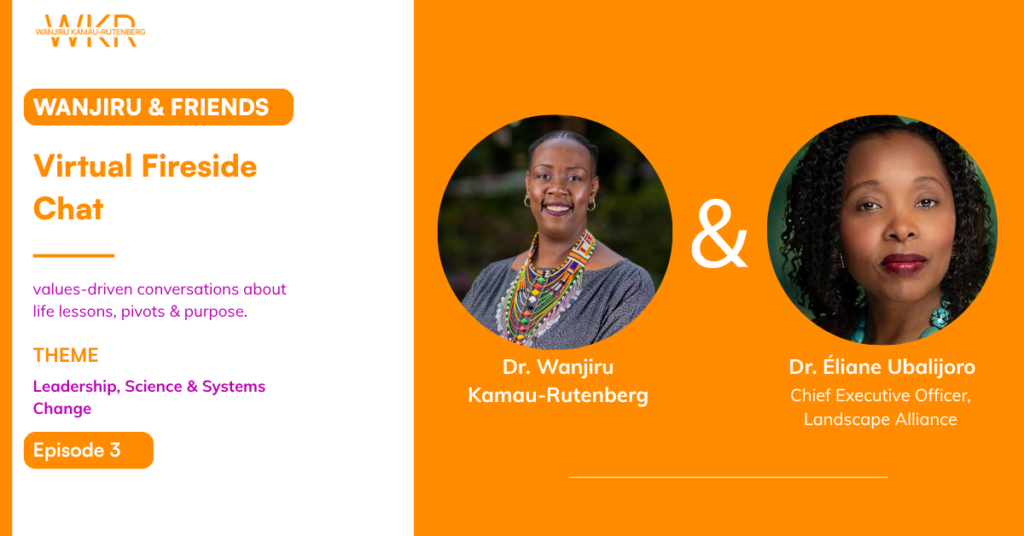
When your appointment was announced, the headline was that you would be the first African woman to serve as Director General of a CGIAR Research Center in the system’s more than fifty-year history. I read that with two feelings at once: pride, and a kind of grief that it took that long. I know the institution you now lead from the inside — I directed AWARD when it was housed at ICRAF, working to move African women scientists from the margins of agricultural research to its leadership. So let me ask you what the press releases never do: what does being ‘first’ actually demand of you day to day? What latitude does it give you, what tax does it impose, and what are you deliberately building so that the second, third and tenth African woman to hold a role like yours inherits a different institution than you did?
There is a huge responsibility that comes with being first. Whatever I do is either going to open doors or close doors for others.
The door is open. My foot is there, keeping the door open. So what am I doing with that opportunity?
I am doing town halls in this organization (Landscape Alliance). I am bringing in leadership training. I want everybody’s potential to be unleashed to the maximum. I want people to be able to bring their whole selves to work, and I want us to understand that working as a community can make us much more powerful than working as individuals.
For me, the opportunity is to ask: how do all the people who allowed me to be the first catalyze me to create opportunities for others to be first in other things?
The tax of being first is that you can operate from a place of fear. You can think, “Oh my God, what am I going to do? I am being scrutinized.” Or you can say, “Wow, I have the opportunity to be the first, to show what I can do, and to inspire others to dream bigger dreams.”
Yes, I was the first African woman to take this position in 2023, but I have been doing this work for almost 30 years. Women who heard me speak 20 years ago are now directors in their institutions. I can already see a generation of women who were influenced long before I came into this role.
Now the question for me is: how do I use everything I have learned scientifically, as a leader and as a human being, and bring all of that to work? How do I enable everyone in my institution to become a catalytic agent within the institution, whether they stay or go elsewhere?
It is about unleashing this community of practice that is looking at the interface between the infrastructure of care and the infrastructure of nature, the enabling financial ecosystem to finance this sustainably and how all this comes together for the global stewardship of how we, as humanity, live within planetary boundaries.
You trained as a molecular geneticist — about as far down into the mechanics of life as science goes — and you now lead an institution whose unit of analysis is the landscape. That is an enormous jump in scale. I lead scientists across nineteen countries, and I have watched brilliant researchers struggle to make the transition you made: from producing knowledge to governing the institutions that produce it. What did the discipline of bench science actually teach you about executive judgment — and what did you have to unlearn? And for the African women scientists coming up behind us, who are so often told to choose between scientific credibility and leadership ambition, what would you tell them about holding both?
There is this great image that I love, from a book that goes from the micro to the macro. It starts with the DNA helix then goes to higher levels of structure. You see the skin of a person, then you see the person’s hand, then you see that person in a park. Then you see a view of the park, a view of the planet, and eventually a view of the cosmos. And the image at the molecular level and at the planetary level look almost exactly the same.
For me, going from being a bench scientist to thinking at the level of landscapes, from being a molecular geneticist to now serving on the African Space Council, is about asking: how do we link the micro to the meta?
It has actually been a very natural path for me because of my interest in both science and the arts, and because of this understanding that the micro and the macro mirror each other.
I started out as an agricultural scientist because I wanted to work with farmers in Africa towards food security. Then I went into the molecular world. And now, from the molecular world, I am coming back to the landscape.
That interconnection, for me, is really key.
On the leadership side, I think who you are on the inside reflects the impact you have on the outside. So be true to your values, so that your impact aligns with who you really are.
It is also about how we live authentically. And how we live authentically mirrors how biological systems work.
Think about a body. What is more important: your heart, your liver or your lungs?
In biological systems, everything works together. And a tiny virus can come in and disrupt the whole body. There is no judgement about how small or how big something is. What matters is how it is interacting with the whole.
When you think about systems at that level, as a scientist, you can take that into how you lead.
How do you lead yourself? How do you lead your small group? How do you lead the organization? How does the organization lead and partner within its field? And how does that influence the whole planetary system?
I am always going from the intimate, the personal, to the collective.
And I think, as an African woman scientist, there is something else that is very important.
Science can be very, very linear. Indigenous knowledge is circular.
It starts with me and my community.
How did I learn sustainability? I learned sustainability from my mother.
In my childhood in Rwanda, there was no garbage pickup. So what did we buy? We bought things that did not require waste, things that could be reused, things that could be returned.
I learned that naturally.
Then, 30 years later, I learned it at university as circular bioeconomy.
And I thought, “Well, that was what my mother always did.”
So I have as much trust in my scientific journey as I do in my authentic human journey.
And it is about how we bring both together.
That is the thing about biological systems. Everything comes together.
The industrial age looked at manufacturing, but it did not always look at the consequences. It did not look at the externalities. It did not look at the system as a whole.
So how I lead as a scientist is influenced by that systems view. It is influenced by the fact that I am a biological scientist. It is influenced by the fact that I am a molecular scientist.
And it is influenced by the fact that I am an African woman, thinking through an African cosmology of “I am because we are.”
That is how, for me, the molecular and the macro all come together.
Here is a tension I want to name between our two institutions. The food systems conversation is still largely organized around crops — my world at the Alliance — while trees are filed under ‘environment’ and handled by yours. Yet you have spent your tenure arguing, from COP platforms to farmers’ fields, that soil health, agroforestry and land restoration are food security infrastructure, not a green afterthought. In African landscapes, the farm and the forest were never separate to begin with; the separation is an artifact of how research and funding got institutionalized. What would it take to genuinely dissolve that border — in science, in finance, and in the CGIAR system we both serve? And where do you see the strongest evidence that tree-based systems are feeding people at scale right now?
I was recently at London Climate Week, at a high-level event on forestry, and one of the discussions was: where are the places where we can plant trees?
And the answer is: on farms.
That is one of the biggest opportunities we have in terms of land area.
So how do we bring agroforestry into how we are looking at carbon sequestration? How we are looking at water towers? How we are looking at bringing corridors of nature onto farms?
How do we integrate trees into the way we think about carbon sequestration? How do we create corridors for nature across agricultural landscapes? Because we have to balance feeding 10 billion people with a landmass that is not changing.
We need to serve the needs of nature and serve the needs of people at the same time. And you see this interconnectedness everywhere.
The same principle applies to water. If you take an area like Naivasha, what happens in the highlands determines what happens in the wetlands below. You cannot separate the two.
If agricultural chemicals are moving downstream into wetlands and affecting biodiversity and birdlife, that is part of the same system. If producers find ways to reduce those impacts, through organic approaches or plant-based processes that ensure what returns to nature is clean, then you begin to see what it means to manage the whole system rather than isolated pieces of it.
That is one of the challenges we face today. We have to stop looking at science in silos, and we have to stop looking at finance in silos.
We cannot calculate how much money is required to achieve the Sustainable Development Goals on one hand, while continuing to finance at much higher levels the petrochemical industry that undermine those goals on the other, as though these activities are happening on different planets.
That is why approaches such as integrated capitals accounting are so important. We need to understand how financial capital, natural capital, human capital and social capital interact. We need to carefully implement a green economy transition that takes the needs and means of all into account.
One of the beauties of agroforestry is that agroforestry has been a really early pioneer at dealing with the messy.
It asks: how do we bring nature and food production together?
Industrialization taught us to put everything into boxes: food here, industry there, cities somewhere else. But that is not how nature works.
Nature is all about interconnectedness and living that interconnectedness.
And now, in a post-industrial age, we have tools that actually allow us to understand more of that complexity. The internet, satellite data and AI are increasingly allowing us to understand these complex connections.
So why shouldn’t our financial systems become more connected? Why shouldn’t the way we think about agriculture and the environment be interconnected?
This is where the idea of nature as infrastructure becomes really important.
Nature as infrastructure allows us to feed our populations. It allows us to have access to clean water. It allows us to have enough trees and enough shade so that we do not have boiling cities and all of the consequences that come with that.
When we do not want to look at complexity, we end up dealing with unintended consequences later.
And to me, that is a poverty mindset, because we actually have the technological tools now to deal with more complexity.
So how do we get the technological tools and human consciousness working together?
It is about collectively dealing with more complexity than we are used to. It is also about not working in silos and not getting into turf wars of, “This is mine, this is yours.”
How do we navigate that complexity while still bringing our collective strengths together?
If we can do that, we can begin to mimic nature and live within planetary boundaries with care.
Before Landscape Alliance (CIFOR-ICRAF) you led Sustainability in the Digital Age and served as Deputy Executive Director at GODAN, the global movement for open agricultural data. You have said you want to combine your institution’s forestry and agroecology knowledge with satellite data and artificial intelligence — including bringing real transparency to carbon sequestration claims. I find this both exciting and dangerous. Carbon markets are pricing African landscapes, AI models are being trained on data about African farms, and the communities who steward that land are rarely at the table where either is governed. As someone who has worked on both sides— open data advocacy and now leading the science — how do we capture the promise of this technology without repeating extraction in digital form? What does African sovereignty over land data actually look like in practice?
Before I came into this role, I worked with two law professors on a major FAO report looking at intellectual property and agricultural data. One of the things we saw very clearly was that countries had very different levels of understanding at the intersection of data, agriculture, and law. Those with greater knowledge were often in a stronger position to negotiate.
So, one of the fundamental questions for Africa is: how do we create a more level playing field in terms of data literacy and harnessing artificial intelligence? How do we deal with issues of sovereignty, while taking into account FAIR and CARE data principles.
African farmers should not just be users of data. They are generators of data. And if they are generating that data, how are they benefiting from the value it creates?
This is what becomes interesting with programmes such as Regreening Africa, where we can combine scientific data with the knowledge being generated by farmers themselves: what trees are they planting? What is growing? What approaches are working? We can bring those different knowledge systems together to understand where value is being created and how regreening efforts can inform larger decisions.
The same applies when we are deciding where farmer-managed natural regeneration may be more accessible and cost-effective, and where we need high-quality tree seed and nursery systems that can fulfil both conservation and dissemination functions.
The broader point is that knowledge is held in all of us. It does not reside only in Silicon Valley.
We as Africans need to generate our own data and train datasets on African data, through our own values. That is an important part of sovereignty.
There is always a great deal of discussion about who owns data, and ownership matters. But we also have to ask another question: who benefits from the data?
We need mechanisms that are fair. We need data commons where information that serves the public good can be made available, while ensuring that value is not captured exclusively by large technology companies.
At Landscape Alliance, one of the things we want our data to do is help de-risk investment in smallholder farmers and Indigenous communities who are stewards of nature. That gives us an intentional purpose for how we generate and use data: to strengthen the agency of the people who are stewarding our food systems and our natural systems.
For me, African sovereignty over land data ultimately means ensuring that the value generated from that data helps create the financial flows needed to support regenerative economies, including for the people and communities who are doing the work on the ground. It means valuing our natural capital while growing economies and ensuring sustainable dignified livelihoods for all.
We are both leading research institutions through the most turbulent funding environment of our careers — development budgets contracting, multilateralism under strain, and the patient capital that science requires increasingly scarce. You sit on a distinctive vantage point: you have been a funder’s advisor, a board trustee at WWF and the Crop Trust, and now a CEO holding an institution steady in the storm. My own career has been spent building things meant to outlast me — Akili Dada, AWARD’s fellowship pipeline, now B-WEL. So I want to close where I always do, on stewardship: when the money is uncertain and the politics are hostile, what do you protect first? What are you building at CIFOR-ICRAF that you are confident will still be standing in thirty years, whoever leads it? And what do you want African women to hold onto from your tenure — not the title, but the practice?
When things become uncertain, the instinct can be to say, “Give me money.”
And that can scare funders.
Someone once told me something I have always remembered: if you ask people for money, they will give you advice. If you ask them for advice, they may give you money.
For me, the deeper point is: how are you presenting who you are, and how are you contributing to the knowledge and wisdom of the people you want to work with?
If you come from a place of scarcity and say, “I am desperate for money,” that is very different from saying, “We are living through turbulent times. What new questions do we need to ask to address what is happening right now?”
That is a much more interesting conversation. Scarcity is a mindset. It is also a lens.
At the moment, we hear one conversation about ODA contracting. At the same time, we are having another conversation about the growth of AI, the wealth it is generating and the potential for new philanthropy.
These are two very different conversations happening at the same time.
And I do not have to choose one or the other. I ask: where is the opportunity?
How do we bring philanthropy, government and the private sector together? How do we use limited ODA in ways that catalyzes greater value? How can philanthropy support the creation of commons and charitable purposes? And how do we encourage the private sector to direct more of the money it is already spending away from extractive systems and towards regenerative ones?
It may not always require more money. Sometimes it requires spending money differently.
The lens through which we look at the world is important.
You can look at the world and say, “Everything is contracting. Everything is under strain.”
Or you can look at the world and say, “AI is unleashing all of this new capacity. How are we going to use it ethically?”
Another question asks how human consciousness can evolve alongside that technology so that we retain our ability to exercise stewardship.
For me, we need to keep looking at the interface between human care, technological tools and the values those tools are serving.
I also know that economies move in cycles.
And if you understand cycles, then you know that this too shall pass.
So I try not to focus only on what is happening right now. I think about five years from now, ten years from now, and much further.
That is where my passion for Indigenous knowledge and the idea of seven-generation thinking becomes important.
I can think three generations back and three generations forward. I can locate myself within something much bigger than this particular moment.
There may be budget constraints right now, but what is going to happen five years from now? Ten years from now? Three generations from now?
For me, it always comes back to this: is the lens I am looking through allowing me to operate from a place of curiosity or from a place of fear?
I will always choose curiosity.
And in choosing curiosity, I am always asking: what is the future I want to design, and how do I work with people who can help me design that future?